Original game by Dicey
Typer Review: Low, Medium or High Risk
One choice shapes every round of Typer: Low, Medium or High. Here is how the three levels differ and what Typer does well.

Shortlist of lobbies to open for Typer
-
1
 Betmach 100% up to $500 + 50 FSPlay now
-
2
 BC.Game Up to 470% over 4 deposits + up to 400 FSPlay now
-
3
 Roobet 100% up to $1,000Play now
-
4
 Mostbet 125% up to $300 + 250 FSPlay now
-
5
 Betsson 100% up to $100 + 100 FSPlay now
-
6
 LeoVegas 100% up to $100 + 50 FSPlay now
18+. Offers and availability depend on your country; read the terms of each casino before you deposit. Please gamble responsibly.
Pick a level first, then start typing
Typer is a text-typing game from Dicey. Before a round begins you select Low, Medium or High risk. That single setting decides how rapid the multiplier grows and how frequently a key concludes the round.
This typer review starts with the levels because they are the only setting that changes the feel of a round. They are also the part that newcomers read wrongly. The listed RTP stays at 97% on all three, so the levels do not make Typer more generous. They change how the results are spread out.
There are no reels here. In Typer you type a phrase, each correct key lifts the multiplier, and you press cash out when you are happy with the number. Behind every key sits a hidden chance of a bust.
Our view is positive but measured. The idea is simple to grasp, and the three levels give honest choices. The weak spot is what the public pages leave unsaid, such as a full table for each level. The figures on this site are approximate ranges, and we label them that way.
A word on how this page is organised may save you some scrolling. The comparison of the three levels comes first, followed by the mechanics of a round, the rules for cashing out and the background of the developer. The casinos and a few short answers come last, in the order in which a newcomer usually asks about them.
Typer suits readers who like to make decisions during play, and it suits them better than anyone who wants a round that runs by itself. Every correct key brings a modest choice, and that steady rhythm of choices is the main attraction of the format.
Low, Medium and High in straightforward words
Low
Small steps of about +0.04x to 0.06x. Roughly a 4-5% bust chance on each key. Ceiling near x150.
Medium
Middle steps of about +0.10x to 0.15x. Roughly an 8-10% bust chance on each key. Ceiling near x500.
High
Big steps of about +0.20x to 0.30x. Roughly a 15-18% bust chance on each key. Ceiling at x1000.
Low: the gradual walk
On Low in Typer you need about 20 to 30 good keys to reach x2 or x3. That is a lot of typing for a modest number. The upside is that a single key rarely concludes the round, since the bust chance sits near 4-5%.
We see Low as the level for learning the phrase and the rhythm. A round feels calm, and the highest figure it can reach is about x150. If you want long, quiet rounds, this is the setting.
Low also tolerates a moment of wandering attention better than the other two levels. A short hesitation costs little when each key carries a bust chance of only about 4-5%, although a run of twenty or thirty keys still adds up. The honest drawback is that the number climbs slowly, so patience becomes part of the price.
Medium: the working compromise
On Typer, Medium needs roughly 10 to 15 keys to reach x2 or x3. Each step is bigger, and each key carries about an 8-10% chance of a bust; the ceiling is about x500.
Most readers will probably settle here. The round is short enough to stay interesting and long enough to leave room for a decision. It asks you to decide where to stop, which is the real skill in Typer.
Medium works well as a reference point because it sits between the other two in almost every column. Its step is roughly two and a half times the step of Low, with about twice the bust chance per key, so the trade is simple to follow on the cards above. If you plan to try only one level of this typer game, we would suggest starting here.
High: the sharp edge
On Typer, High climbs fastest. About 5 to 8 keys can take the multiplier to x2 or x3. The price is a bust chance in the range of 15-18% on every key.
This is the only level with the x1000 maximum, and that figure draws the eye. Treat it as a ceiling, not a target. The typer max win figure describes the furthest a single round can climb, and it says nothing about how frequently anyone gets near it. With a bust chance of about 15-18% per key, long runs on this level are the exception by design. A $0.10 stake at x1000 would be $100, but most rounds on High end far below that or end early.
What the three have in common
The ceilings give a feel for the spread. On a $0.10 stake, about x150 on Low is about $15, and about x500 on Medium is about $50. These sit at the upper end of each range, so do not read them as typical.
The typer rtp of 97% is the same on every level, and that is the detail which surprises people most. A higher level is not a better deal, and a lower level is not a worse one. The levels reshape the same average into modest, frequent results or large, infrequent ones.
Over $1,000 staked in total, 97% corresponds to $970 returned on average across a very large number of rounds. The session you play will look nothing like that average. Scale the stake up and the picture stays the same: at $1.00 a cash out at x2 returns $2.00, and the ceilings become $150 on Low, $500 on Medium and $1,000 on High.
How a round of Typer works
Every round rests on a phrase. You can type one of your own, or you can select Random Words, which supplies real words of the length you need. A phrase may be as long as 50 characters.
Preview lets you read the phrase before the first key. That matters, because the keys you press must match its characters. They are not random keys, so an awkward phrase makes the round harder than it needs to be.
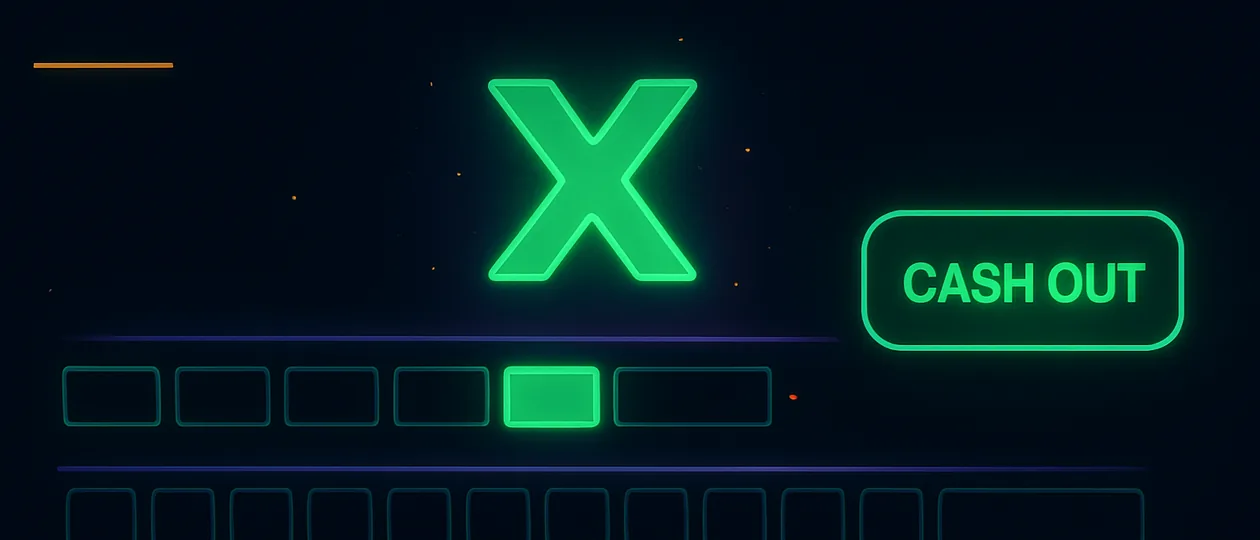
Once the round runs, each correct character moves the multiplier up one step. Each key also carries its own hidden chance of a bust. The size of the step and the size of that chance both come from the level you chose.
The Typer stake is shown in USD and paid in the coin you select. We read the minimum as about $0.10, and the maximum at round start as about $100 to $500. Both are approximate, so check the limits in the casino you use.
The phrase deserves some thought before the first key. A short and familiar line is simple to follow, while a long line of unusual words asks for concentration across up to 50 characters. Random Words is a convenient middle path, because it gives real words of the length you need and spares you the effort of inventing a line.
Typer makes an unusual design choice by building a multiplier game around keyboard input instead of a single button. As a consequence, your own accuracy and attention become part of the experience, and that gives the format a character which an ordinary multiplier game does not have. A reader who enjoys typing will probably find this appealing, and a reader who dislikes it can try the demonstration first and decide afterwards.
Cash out and bust
Cash out in Typer is available at any moment after the first correct character, as long as the round has not busted. Before that first key there is nothing to collect; after it, the choice is yours alone.
A bust in Typer works the other way round. The round stops at once, the multiplier is cancelled and the stake is forfeited in full. Nothing is paid out for the keys you typed before it.
There is a psychological side that a reviewer should mention. The multiplier keeps rising, and each extra key feels cheap once the previous one has succeeded. The sound approach is to settle on an exit before the round starts, because the decision is much harder once the number is moving.
We like that the exit rules are this straightforward, and you always know the two ways a round can end. The difficult part is not the rule but the habit of pressing the button before the number feels substantial enough.
A simple example shows the idea. At a $1.00 stake, cashing out at x2 returns $2.00, and a bust returns nothing. The gap between those two outcomes is the whole game.
The developer, and where Typer sits among Dicey originals
Typer was developed by Dicey and released on 6 October 2026. Dicey describes it as one of its own originals, a family of in-house games built on a shared fairness method. The originals use HMAC-SHA256 for their checks.
The list of Dicey originals is Space Draw, Dice, Limbo, Blackjack, Keno, Mines, Plinko, Coinflip, Dig Dig, Throne Tower and Typer. Typer is the only title there whose name points to typing. Its keyboard format is the clearest break from the rest of the family.
That matters for two reasons. Typer follows a method Dicey already uses elsewhere, and the checks are not special to Typer. You can read more about that method on the features page.
Anyone searching for dicey typer will find that it points to Typer, the Dicey original, and not a separate product. A newcomer who has met the other originals will recognise the fairness check, while one who has not loses nothing, since Typer explains its own rules. The unusual part is the input, because Typer is played on the keyboard.
Before you open a casino
A typer casino is simply a casino that lists Typer in its lobby. The offers further down the page are welcome bonuses from six casinos in a fixed order. Typer is not confirmed in every lobby.
A welcome bonus is optional, and Typer can be played without one. If you take a typer bonus, compare the wagering and the bonus period on the casinos page and do not look only at the percentage.
Offers, terms and game availability depend on your country and on the casino. Check the lobby and the terms before you deposit. Play only if you are 18 or older, and keep to a budget you set in advance.
Open one of the casinos below and look for Typer in its lobby.
Six casinos, one fixed order
-
1
Betmach 100% up to $500 + 50 FSPlay now
-
2
BC.Game Up to 470% over 4 deposits + up to 400 FSPlay now
-
3
Roobet 100% up to $1,000Play now
-
4
Mostbet 125% up to $300 + 250 FSPlay now
-
5
Betsson 100% up to $100 + 100 FSPlay now
-
6
LeoVegas 100% up to $100 + 50 FSPlay now
18+. Offers and availability depend on your country; read the terms of each casino before you deposit. Please gamble responsibly.
Typer review: common questions
Yes, there is a demo with a virtual balance. It needs no registration and sits on the Typer page. Real stakes need a casino account and a deposit.
Each key adds more on a higher level, about +0.04x to 0.06x on Low against about +0.20x to 0.30x on High. The bust chance per key grows as well. The RTP stays at 97% on all three levels, so the higher setting is faster, not more generous.
The text can be up to 50 characters long. You can type your own phrase or use Random Words, and Preview shows it before the first key.
Typer was developed by Dicey and released on 6 October 2026. It is one of the Dicey originals, along with games such as Dice, Limbo and Mines.